
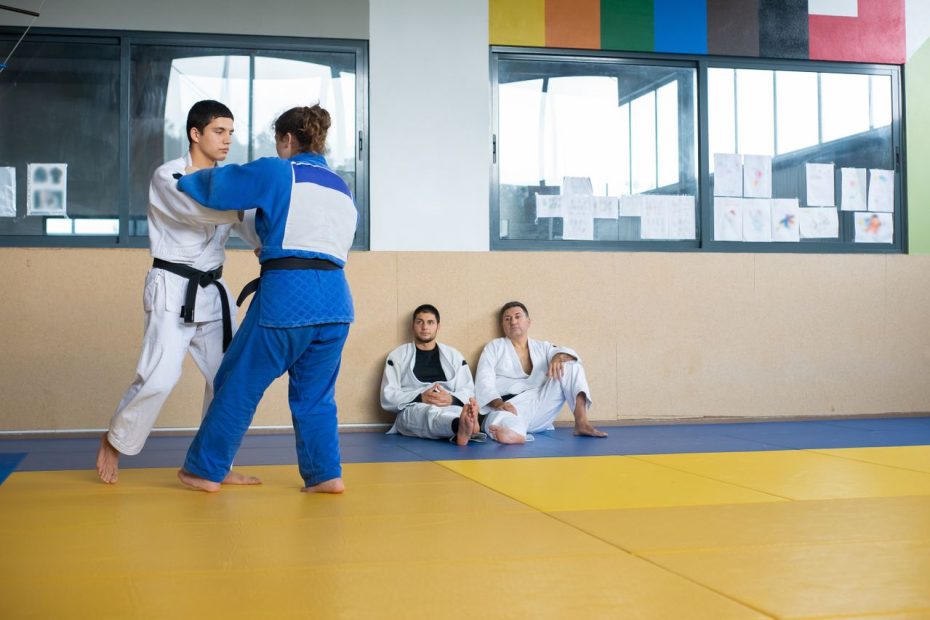
Kayla Harrison and judo-to-MMA crossover matters because her career shows how an Olympic grappling base can become more than a credential in mixed martial arts. Harrison did not enter MMA as a general prospect with a vague combat background. She arrived as a two-time Olympic judo champion whose best skills—grip fighting, balance, trips, throws, top control, and submission pressure—translated directly into the cage. Her move from judo to the PFL and then the UFC helped prove that judo could still be a serious MMA foundation when adapted to strikes, cage positioning, and modern defensive wrestling. Her career is a bridge between Olympic discipline and professional fight evolution.
Why Kayla Harrison’s Judo Background Was Built for Control
Judo is often remembered by casual combat sports fans for spectacular throws, but Harrison’s value as an MMA prospect was deeper than highlight takedowns. Elite judo is built around hand fighting, posture breaking, balance disruption, and the ability to turn small positional advantages into decisive attacks. Those skills matter in MMA because the cage rewards fighters who can control where the fight happens.
Harrison’s Olympic success came at 78 kg, where strength alone was never enough. She had to manage distance, win grips, time entries, and finish exchanges against world-class opponents who had spent years preparing for the same battles. That background gave her a form of combat fluency that most new MMA fighters do not have. She already understood pressure. She already understood tournament stakes. She already understood how to impose a preferred fight shape on an opponent.
The challenge was not whether Harrison could grapple. The question was whether she could make judo work in a sport with punches, kicks, cage walls, longer rounds, and opponents who were training specifically to avoid her strengths.
Kayla Harrison and Judo-to-MMA Crossover Became a Professional Blueprint
Harrison’s MMA rise showed that judo could become a complete cage-fighting base when paired with the right adjustments. In the PFL, she built her early professional identity around physical control, takedowns, top pressure, and submissions. Her judo did not appear as a separate martial art placed inside MMA. It became part of a broader system: close distance, force contact, break balance, reach dominant positions, and keep opponents working under pressure.
That made her different from fighters who use judo only as a surprise tool. Harrison’s crossover was structural. Her clinch work shaped the fight. Her takedown threat changed how opponents stood with her. Her top game made every exchange feel connected to a larger problem. Once opponents had to defend the throw, they also had to defend the follow-up, the pass, the pin, the submission, and the strikes that came from being trapped underneath her.
Her UFC debut against Holly Holm sharpened the point. Holm was a former boxing and UFC champion with extensive high-level experience, but Harrison’s grappling pressure quickly became the defining force of the fight. The result mattered because it placed Harrison’s Olympic-to-MMA transition on the sport’s biggest stage, not as theory but as proof.
What Harrison’s Move Changed About Judo’s Place in MMA
Harrison’s career matters because judo has often been treated unevenly in MMA discussions. Wrestling and Brazilian jiu-jitsu are usually framed as the core grappling languages of the sport, while judo is sometimes reduced to a few throws or individual examples. Harrison pushed against that narrow view. Her success showed that judo can be a full competitive base when the athlete adapts it to MMA’s realities.
Her path also widened the model for Olympic athletes entering professional fighting. Ronda Rousey had already shown how devastating Olympic judo could be in women’s MMA, especially through throws and armbars. Harrison extended the conversation by building a longer professional arc across multiple organizations, weight classes, and stages of competition.
The larger legacy is not that every judoka can become an elite MMA fighter. The lesson is more precise: Olympic judo gives a fighter powerful tools, but those tools have to be rebuilt for the cage. Harrison’s career shows what that rebuilding can look like when the athlete brings world-class technique, physical discipline, and the willingness to become a full mixed martial artist.
Kayla Harrison’s judo-to-MMA crossover remains important because it connects two versions of combat excellence. Olympic judo gave her the foundation, but MMA required adaptation. Her career shows that the best crossovers are not simple transfers of skill. They are translations, and Harrison translated one of the world’s most demanding grappling sports into a championship-level MMA style.













Pingback: iphone duo price comparison
Comments are closed.