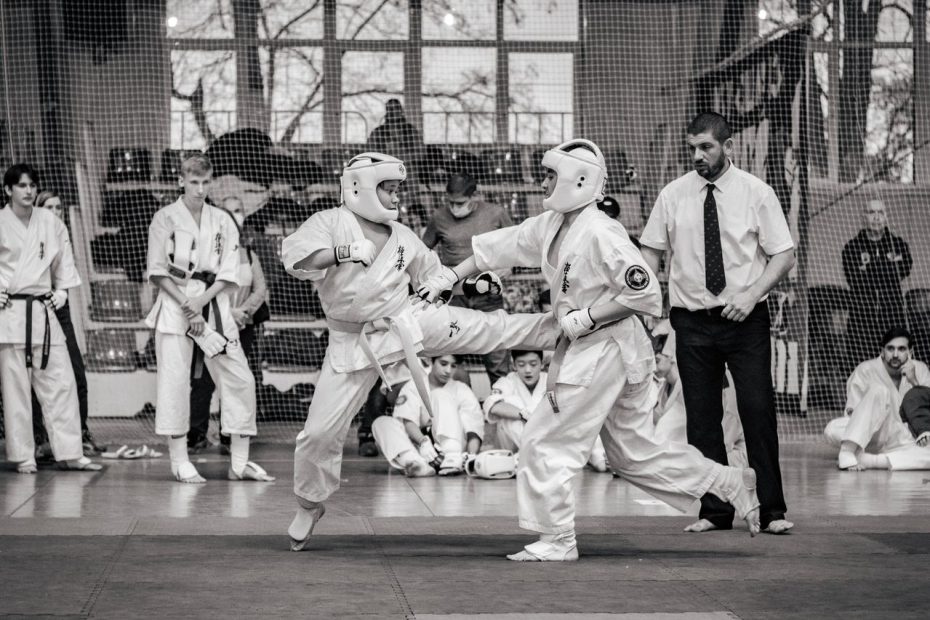
The karate gold-medal disqualification at Tokyo 2020 became one of the most unusual endings in Olympic combat sports because the athlete who appeared to land the decisive strike did not win the final. In the men’s kumite +75 kg gold-medal bout, Saudi Arabia’s Tareg Hamedi led Iran’s Sajad Ganjzadeh before a high kick ended the contest and left Ganjzadeh unable to continue. The judges disqualified Hamedi by hansoku, awarding Olympic gold to Ganjzadeh. The moment mattered because it exposed the gap between how casual viewers understand fighting and how Olympic karate defines control, safety, and legal scoring.
Karate Arrived at the Olympics With Its Own Rules of Control
Karate made its Olympic debut at Tokyo 2020, and kumite was not designed as a simple knockout contest. Unlike professional boxing or many forms of full-contact combat sports, Olympic karate rewarded clean, controlled scoring techniques within a rule set built around precision as much as impact. That distinction became crucial in the final bout of the men’s +75 kg division.
For viewers unfamiliar with elite karate, the confusion was understandable. Hamedi’s kick looked decisive in the most basic combat-sports sense: he landed, his opponent went down, and the match stopped. But Olympic karate was operating under a different standard. A technique could score only if it met the sport’s expectations for control. Excessive contact could turn a successful-looking strike into a penalty, even in a gold-medal match.
That tension was already built into karate’s Olympic debut. The sport was trying to present its highest-level version to a global audience while many casual viewers were still learning how kumite differed from other combat sports. The final made that difference impossible to ignore.
The Karate Gold-Medal Disqualification Turned One Kick Into the Whole Story
Hamedi started the final strongly. He scored early and led 4-1 before throwing the kick that changed the bout. The strike landed high on Ganjzadeh, who fell to the tatami and required medical attention. After review, officials ruled the contact excessive and disqualified Hamedi. Ganjzadeh was awarded the gold medal, while Hamedi received silver.
The result created immediate tension because the visual logic of the moment and the rule logic of the sport seemed to point in opposite directions. To many viewers, Hamedi appeared to have produced the defining attack of the match. Under the rules, that same attack crossed the line from scoring technique to disqualifying contact.
That is why the moment traveled so widely. It was not simply an unusual Olympic result. It was a public collision between two ideas of fighting: one based on visible damage and another based on controlled execution. Olympic karate chose the second standard, even when it meant awarding gold to the athlete who could not continue.
Why the Tokyo 2020 Karate Final Still Matters
The Tokyo 2020 karate final still matters because it became the most memorable example of karate’s brief Olympic presence. Karate was not included in the Paris 2024 Olympic program, which gave the Tokyo tournament an added sense of finality. For many viewers, the last image of Olympic karate was not a clean celebration of victory but a difficult rules decision that demanded explanation.
That does not make the bout a failure. It makes it revealing. Combat sports are often judged by instinct from the outside, but each discipline has its own internal logic. Boxing, wrestling, judo, taekwondo, MMA, and karate all define success differently. The Hamedi-Ganjzadeh final forced a global audience to confront karate on its own terms.
For Hamedi, the moment became a painful near-gold story. For Ganjzadeh, it became an Olympic title won under deeply unusual circumstances. For karate, it became a lasting case study in the sport’s central demand: power must be paired with control.
The karate gold-medal disqualification remains one of the rare Olympic combat-sports moments where the rulebook, not the highlight, decided the story. That is why it still stands out. It showed that in Olympic karate, the cleanest path to victory was never just landing the strike. It was landing it within the discipline the sport required.